

Please wait..
Please wait..
01-May-2026 Plan Your Stay
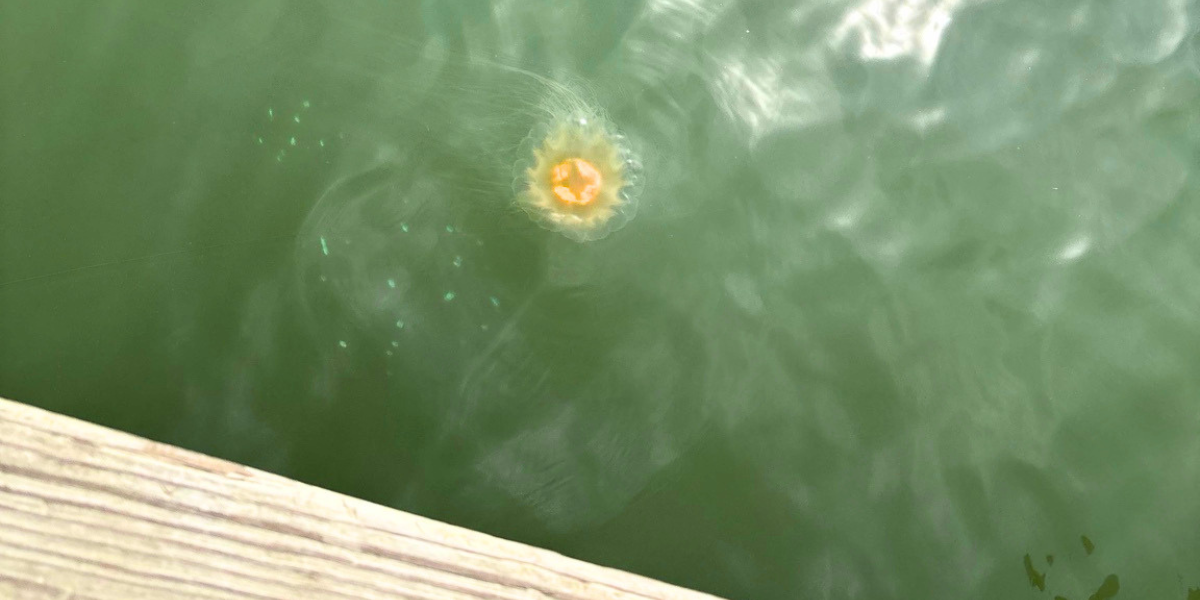
If you’ve been out by the water lately—especially in the spring—you may have noticed small, almost transparent jellyfish drifting by… each with a distinct orange center.
At first glance, it can raise the question: Is this something to worry about?
The short answer is no.
But it is something to understand—so you can enjoy the Bay fully, comfortably, and with confidence.
What you’re seeing are young Chesapeake Bay sea nettles, a native jellyfish that appears seasonally as the water begins to warm.
That bright orange circle in the center?
It’s simply part of their anatomy—their reproductive organs—and it’s often more visible in younger, smaller nettles like the ones that show up in spring.
At this stage, they’re typically:
~About 3–4 inches in diameter
~More translucent
~Equipped with shorter, finer tentacles
In other words, you’re catching the early phase of their seasonal cycle.
Even though they’re small, sea nettles can look a little intimidating—especially with their trailing tentacles and that bright orange center. It’s completely natural for both adults and kids to feel unsure at first.
Sometimes it helps to reframe what you’re seeing: they’re not “out to get you”—they’re just drifting with the current, doing what they’re meant to do as part of the Bay’s ecosystem.
For kids, a simple way to explain it is:
“They’re like floating sea creatures with tiny stingers, so we just give them a little space—just like we would any animal in nature.”
Yes—sea nettles can sting. And it’s okay to say that clearly. But here’s where it helps to separate perception from reality.
The sting doesn’t come from how they look (including that orange center). It comes from contact with their tentacles.
For most people, especially this time of year, the sensation is brief and manageable—often described as a quick sting or tingle rather than anything severe. Kids may be more sensitive, so helping them understand what to expect ahead of time can make all the difference in how they experience it.
And right now, in the spring:
~Tentacles are usually shorter
~Encounters tend to be more mild
~They’re easier to see and avoid
As the summer progresses, sea nettles grow larger and their tentacles become longer and harder to spot—this is when people are more likely to feel a stronger sting.
Absolutely.
Swimming is still very much part of the Chesapeake Bay experience.
Like many natural environments, it simply comes with a bit of awareness:
~Be mindful of where you’re stepping or swimming
~Avoid brushing against jellyfish if you see them
~Consider water shoes for added comfort
~Rinse with saltwater (not fresh) if you have a minor encounter
For most people, stings are temporary and manageable, more surprising than serious.
If you’re visiting with kids, a few simple tips can help them feel confident:
~Point them out ahead of time so there are no surprises
~Encourage “look, don’t touch” curiosity
~Let them know it’s okay to get out and take a break if they feel unsure
~Keep the tone calm—kids take their cues from you
One of the things guests love most about staying here—whether in The Cottage or one of our other waterfront accommodations—is the direct connection to the water…the calm mornings, the sparkling afternoons, the sense of space and ease that comes with being right on the Bay.
Sea nettles are simply part of that living, breathing ecosystem.
Right now, what we’re seeing is the Bay just beginning to wake up for the season.
And that means:
~Beautiful water conditions
~Early signs of summer
~And a chance to experience the Bay in its more peaceful, less crowded phase
You don’t need to avoid the water. You just want to be in relationship with it.
A little awareness goes a long way—and once you understand what you’re seeing, it stops feeling uncertain and starts feeling like what it really is:
Part of the rhythm of the Chesapeake Bay.
If you’re planning a visit, you can explore your stay options here and we’re always happy to share real-time water conditions and tips.

Shawn
Online